Showing posts with label Erdogan. Show all posts

Saturday, 16 July 2016

If it looks like a Thing, it must be the Thing...right?

Last night's attempted coup was swiftly dismissed - but was it all a piece of political theatre?


Military coups are never nice things - you just know hat someone is going to come out of one horribly, whichever way the dice roll.

For President Erdogan, the dice seem to have landed remarkably fortuitously.

Turks are wearily familiar with military takeovers - they've endured four previous coups since the end of the Second World War, the latest being in 1997. The takeover of 1980, which was particularly brutal, lingers long in the collective memory.

This attempt, however, was - well, different.

It looked a bit too much like a coup, for starters. Yet it didn't actually do what coups do. The plotters took over one news agency, and one TV station. They posted tanks outside two airports and across two bridges. They positioned tanks around a relatively small number of public buildings, including the TCBM (Parliament) building. They issued a statement from a group calling themselves 'The Council for Peace at Home'. They had command of a handful of helicopters and, it appears, at least one jet.

In short, they did everything to ensure it looked all coup-shaped.

However, no one told the conscript soldiers that. No one told the police that. No one told the Jandarma (civil militia) that. So what happened? People started dying and getting wounded - as I write, some 90 dead and over a thousand injured.

If this was a coup, why only action in Istanbul and Ankara? Why so few soldiers? And how did they get their hands on just enough equipment to give the impression that it was something bigger? Why were they so inadequate in supressing information and in disseminating their own message? I didn't see a single 'official' coup Twitter handle or any other sign of even basic social media skills.

If this was a coup, why were ministers on the air almost from the beginning? Why had there be no attempt to seize them or the President, who was on holiday, and was able to get on a suspiciously convenient jet? How was he able to land at Istanbul's Ataturk Airport for a suspiciously well-timed press conference?

If this was a coup, why was it that the streets ended up being flooded with AKP supporters so quickly? How did they get their hands on both AKP and Turkish flags of such regular size and shape so quickly?

I am no great fan of conspiracy theories: I believe far more in the infinite human capability to bugger things up without the need for an elaborate plan to do so. in this case, however, it seems the likeliest possibility.

The whole of Turkey has, as the saying has it, been sold a pup.

Everyone has been gamed: The coup leaders who thought they were planning a real coup, their conscripts who were ordered to do their duty, the police and the Jandarma who thought they were doing theirs, and the populace took to their role without even knowing it, and went onto the streets.

And Erdogan now gets this:
No more questions about his fake university diploma.
No more questions about his backhanded dealings, his corruption, his graft.
No more questions about selling weapons to ISIS.
No more questions about his megalomania.
No more questions about changing the constitution in order to change the style of government.
At a stroke, he comes across as both the man of steel and the saviour of Turkish democracy, and he closes in on his long-term goal: Absolute rule.

The great theatrical practitioner of Turkish politics has probably pulled off his greatest show, and his adoring public are happily lapping it up.

Forget the dead, forget the injured, forget the poor conscript on the Bosphorus bridge who allegedly had his head hacked off by a baying crowd of Islamists, forget the arrested, forget the tortures and arbitrary executions to come - they're just the grease that slicks the way to the president's throne.

Wednesday, 24 February 2016

Hand in hand

In Turkey, the way to do business is to create an almost familial relationship - but too often, government and big business are too close for comfort.


When I first arrived in Turkey, I found it fascinating, sometimes exhilarating, often confusing, occasionally infuriating amd, where relationships between people were concerned, somewhat....weird.

Take touching, for instance. We Brits are not famed for physical contact: If someone brushes pasr us accidentally, we become a flurry of 'excuse mes' and 'sorrys'. It;'s weird that we say 'sorry' to the person who has intruded on our personal space. As for having accidental leg contact as you sit down on a bus or train, that's basically Social Armageddon.

Turkey, by contrast, is much more touchy-feely - but outside the immediate family, only so between people of the same gender. Men walk down the street with their arms round each others shoulders, or walk arm-in-arm. They kiss each other on the cheeks (OK, an air kiss, but it still kissing between men). A colleague, one evening, went to link his arm in mine, and I more or less jumped across the road.

Obviously, I got used to it as time went on: We all learn to understand (if not necessarily appreciate) the ways and means of other cultures as we live within them.
I found it difficult to understand, however, when it came to work and business. The Turkish way of getting things done is far more circumlocutory that what we consider to be good practice here in the UK. It's all about building close relationships, creating familiar bonds. It sometimes feels, to outside eyes, that the relationship is actualy far more important than the work itself. And there's a very distinct atmosphere of 'You scratxh my back, I'll scratch yours' about it. Nowhere is this seen more than the way in which the government awards contracts to its favourites.

OK, business and government cosying up to each other is nothing new - it's just that we do have strict laws in place regarding competition and the awarding of contracts. This doesn't really happen in Turkey, and it has become far worse since the AKP took control.

Let me take you somewhere pretty by way of illustration. This is Artvin, in the North East of Turkey:

Pretty, isn't it? It's famed for its beauty, its green pastures, its mountains and its people - some call it the home of poetry.
And this is where a company called Cengiz Holdings is trying to whack open a bloody huge copper mine and chop down (allegedly) over 50,000 trees. For the past fortnight, there have been violent clashes between protestors and police and gendarmerie (Jandarma) units. The police have been acting with impunity and have been taking orders directly, according to reports, from the mine owners. As of a few hours ago, the Prime Minister, Ahmet Davutoglu, has ordered a halt to mining operations prior to a judicial decision, expected within  the next few days.
Right, so you're probably wondering 'so what?' right now.  It's probably best to look at this company and its owner, Mehmet Cengiz, a little more closely.
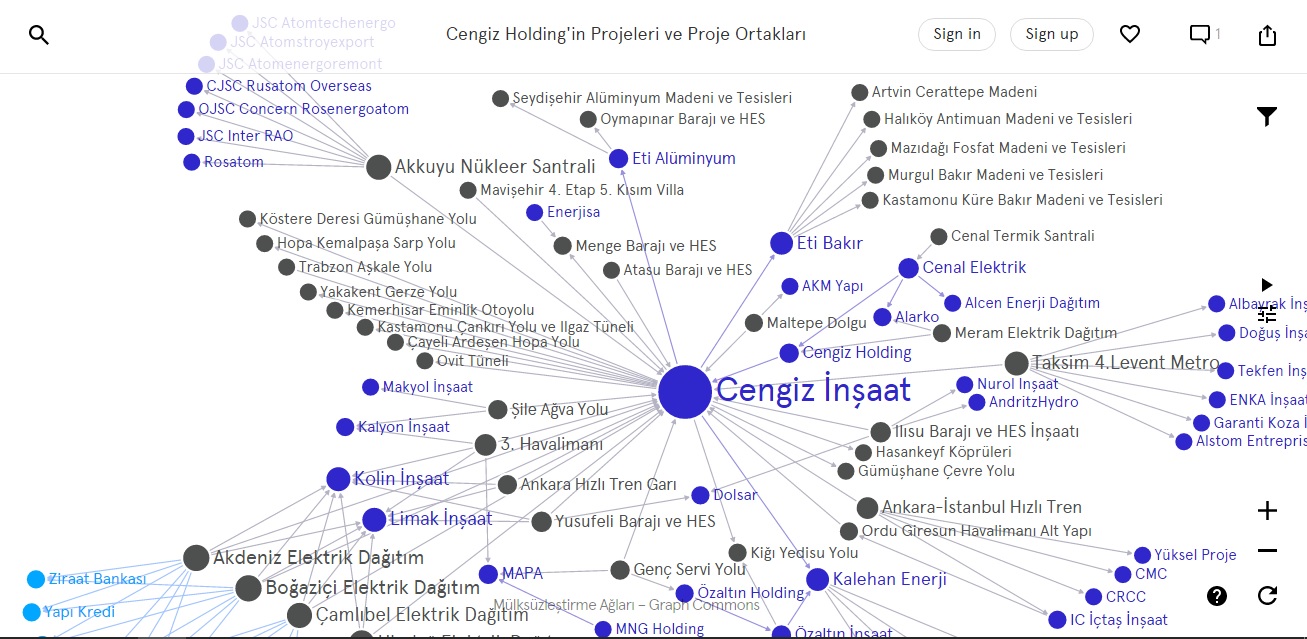
Anyone who cast an eye over the company account books couldn't help but approve - the balance is looking very favourable, thank you very much. A little too favourable, however. And it seems to have a remarkable ability to win very large capital infrastructure projects. This illustration shows some of the work they have done or are engaged in, including the third Bosphorus Bridge and third Istanbul Airport:

In fact, since the AKP came to power, it has won pretty much every big project that's been put up for competitive tender. It seems that the ruling party like them very, very much, because not only have they handed over all these projects, but they also wrote off the 424 million lira (currently about £100m) debt Cengiz Holdings had to the taxman.
And guess who happen to be best buddies? Why, Mr Mehmet Cengiz and Mr Recep Tayyip Erdogan, President and former Prime Minister of Turkey, of course.
This is only one example. It is remarkable how many of the ruling party are very, very rich men who seem to have become much, much richer over the last decade. Not that it quite goes all their way: Erdogan was at the centre of a wiretapping scandal where he was caught discussing with his son Bilal about ways of getting rid of a siazeable chunk of cash. Indeed, Erdogan Junior is currently facing money laundering charges in, of all places, Italy. Now, if the Italians are throwing the book at someone for dodgy financial dealings, you know it's got to be serious.
 However, I will point out that this kind of chicanery is nothing new in the country - indeed, the political elite have always been the richest in the country and have always walked arm in arm with whoever would make them richer. The AKP, in fact, came into power on the premise that they were not like this, that they would bring, well, Justice and Development - hence their party name. Instead, they have turned out to be even worse than the venal, corrupt old political guard, because they use the veil of faith to hide their dirty tricks. I suspect there's a bit more than a bit of touchy-feely when it comes to the relationship between Erdogan and Big Business.

Tuesday, 16 February 2016

Nero's Fiddle

Since I wrote that last article, my predictions have unfortunately come more or less true. The Turkish state is currently in a de facto civil war in the South East, literally razing whole sections of cities to the ground, and appears to be creeping ever closer to a full-scale ground invasion of Northern Syria. I cannot emphasise too strongly how dangerous this situation is on a global scale, as the potential for all-out conflict between Turkey and Russia also risks drawing in NATO.

Russo-Turkic wars have never ended well.

But WHY is it happening? What is the Turkish government playing at? After all, it could sit to one side, halt all border movement towards Syria, wait for the outcome and play the Peace Broker card: It could genuinely make a difference, and help create stability, across the entire region. Just four years ago, it was in a position where it could have done this, yet the opportunity, and others like it, have slipped by one by one.

And why? For such a complicated issue, there is a single easy answer. His name is Recep Tayyip Erdogan, president of the Turkish republic.

Now, I'm not usually one for pointing the finger of blame at a single person and saying that any given situation is all their fault, but in this case, I think I comfortably can. Erdogan will do anything whatsoever to hold on to power, and the fact that he wasn't able to get more control over the country last year has had a profound effect on the state's actions ever since.

In a nutshell, the ruling AKP did not achieve enough seats in last May's General Election to push through a constitutional reform that would have effectively made Erdogan President for Life. The pro-Kurdish HDP, in the meantime, received more than 10% of the votes, meaning it could be represented in parliament. Very briefly, there was hope that Turkey was on the verge of a new kind of democratic participation.

And then Erdogan, in effect, restarted the civil war with the PKK. I should point out that the AKP were instrumental, several years ago, in bringing about a ceasefire and had actually increased the rights of Kurds, including crucial concessions on the official use of Kurdish. The decades-long conflict had abated, and there was a very clear consensus on trying to find a peaceful solution. Unfortunately, this idea was sacrificed to Erdogan's personal aims: keep power at any cost. By starting the war again, he was able to represent himself as a defender of Turkish rights and, in a snap election later in the year, the AKP gained a majority in parliament once more.

It gets nastier. Since then, the HDP have had offices firebombed, their representatives attacked, arrested and imprisoned, and labelled 'terrorists'. And that label has now been applied to journalists (who have always been the target of arrest in Erdogan's Turkey), lawyers, academics and even medical staff, in fact, anyone who says anything remotely critical of him. The entire state is being pulled down in the name of one man.

Rather similar, in fact, to the situation with Vladimir Putin in Russia.

The situation in some parts of Turkey is distressing. Photos from Cizre and Diyarbakir look as if there were shot in Homs or Aleppo, and last week in the former, an estimated 100 people were reported to have been burnt alive by the military. On its borders, it's no better: The army is shelling positions held by the Kurds as they fight ISIS and the Syrian Army. The reason for this is to prevent a de facto Kurdish state developing between northern Iraq and the Mediterranean. The AKP would prefer to deal with (and I know this takes some believing) ISIS: It's been clearly established that the government has been supplying arms to the group.

And all this misery comes down to a single man and his single quest for singular control. By playing with fire, Erdogan could end up burning the whole country. The thing is, he gives the impression of not caring if this happens - he'd rather be sultan of a kingdom of ashes than no sultan at all.